

Quick guide
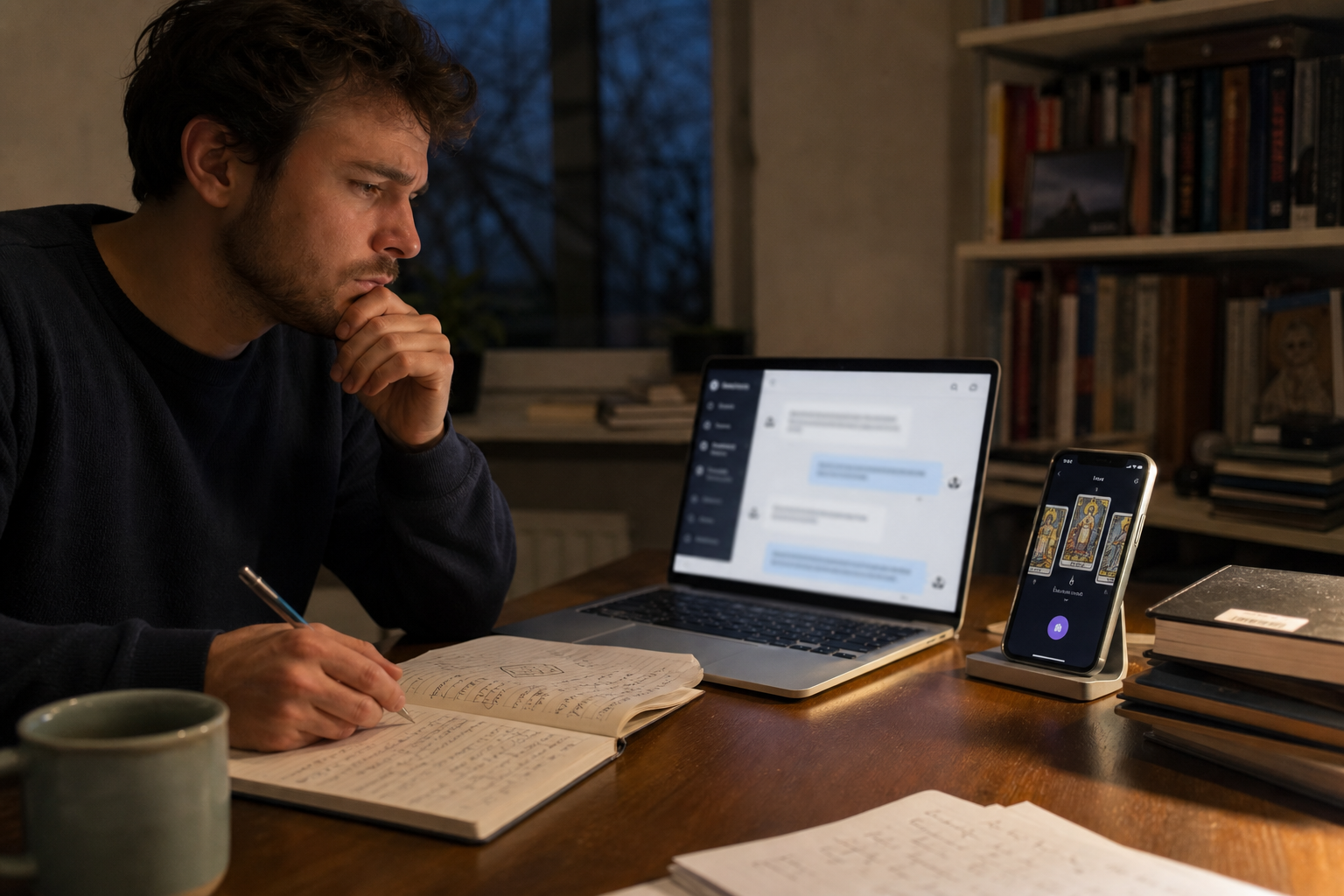
Neither AI nor a human psychic reads “energy”, because there is no energy field to read. What both do is respond to cues. An AI system can classify tone of voice, facial expression, word choice and typing rhythm and label them as stress, sadness or enthusiasm, with real but limited accuracy. A human reader does the same with more context, more warmth, and the ability to ask a follow-up question. The difference that matters is not that one “feels” and the other “calculates”; it is that one is a person who can care about you and be held to account, and the other is software with a business model. This guide explains what emotion AI actually does, what a reading actually is, how AI-generated readings are now sold, and how to judge any reading by the same standard.
What emotion-recognition AI can and cannot do
The field called affective computing, established at the MIT Media Lab by Rosalind Picard in the 1990s, builds systems that infer emotional state from observable signals: facial movement, voice pitch and pace, word choice, heart rate from a wearable, even keyboard timing. The lab’s own explainer on emotion AI is clear about the limits: the systems detect expressions, not feelings; a smile can hide grief; the same signal means different things in different cultures and contexts; and the accuracy claimed by vendors is often far higher than what independent tests find. Customer-service systems that flag “frustrated” callers, wellness apps that track mood from typing, and chatbots that adjust tone are all applications of this, and all are pattern-matching on surface cues.
That is worth stating plainly because the previous version of this article, like much writing on the subject, described AI as detecting “frequencies” and “vibrations” and human intuition as feeling them. There are no frequencies. There are cues, and two kinds of system that respond to them.
What a “reading” is, whoever gives it
- Cues in Words, tone, face, posture, what you volunteer, what you avoid. A machine gets a subset; a person in the room gets all of it.
- Pattern out “You’ve been under strain lately”; “there is someone you haven’t forgiven”. Statements that fit most people, refined by your reactions.
- Feedback loop You confirm or correct, and the next statement adjusts. Chatbots and readers both do this; readers do it better.
- Meaning added The reader frames it as intuition or spirit; the app frames it as an algorithm. You supply the sense that it was about you.
This is the structure of cold reading, and it explains why AI tarot apps feel “right but hollow”: they run the loop without the warmth. See how to check a psychic’s claims.
What a human reader actually brings
Strip away the vocabulary and a good reader offers four things a program does not. Attention from another person, which is scarce and valuable in itself. Context: the ability to notice that you flinched at a name and ask about it. Accountability: a person with a reputation, a platform review page and, in principle, a refund policy. And care, which cannot be faked for long. None of these require any ability to perceive energy; they are the ordinary skills of a good listener, and they are why people leave a good reading feeling better. They are also what an honest reader is judged on.
What a human reader also brings, and a program does not, is the capacity to exploit. The curse-removal script, the rebooking pressure, the “your energy is blocked” pivot are human inventions. An AI tarot app will not tell you that you are cursed unless someone programmed it to, and some have been.
How AI readings are sold now
| Product | What it actually is | What to watch |
|---|---|---|
| AI tarot and astrology apps | A card or chart drawn at random plus a language model writing an interpretation | Fine as a reflection prompt; see tarot for wellbeing. Subscriptions and “premium insight” tiers add nothing |
| “Psychic” chatbots on reading platforms | A language model answering in a reader’s persona, sometimes without disclosure | Whether the site tells you it is AI. How psychic websites should disclose AI advice sets out what to expect |
| “AI aura scanners” | Face or hand analysis mapped to colours, like a festival aura camera with software | Decorative. See what is your aura? |
| Readers using AI prep tools | Sentiment analysis of your emails or intake form before the session | It means the reader knows more about you than the reading will reveal. Ask what they read beforehand |
| Companion chatbots marketed for comfort | Language models trained to be warm and agreeable | Can help in the short term; not a substitute for people, and known to keep users engaged rather than helped |
Ethics: the part the industry does not like discussing
Emotion detection raises a consent problem: a system that flags your mood from your voice or typing is collecting sensitive information, often without telling you, and sometimes to find the moment you are most likely to buy. Reading platforms that combine per-minute billing with mood analysis have a direct incentive to detect vulnerability. Human readers have the same information from your voice and use it with the same range of motives. The safeguards are the same for both: know what is being collected, know who is on the other end, set a budget before you start, and treat any pivot to fear as the end of the session. How the industry is moving toward transparency covers what to expect from platforms.
How to judge any reading, human or machine
- Was it about your question? Or did it drift to generalities that fit anyone?
- Did the information come from you? Count what you told it before it “knew”.
- Did it leave the decision with you? A reading, from a person or a program, that tells you what to do about money, health or a relationship is out of its depth.
- Did it try to keep you? Rebooking pressure, subscription nudges, “the reading isn’t complete”. Same tell, different medium.
- Was it honest about what it is? A reader who says “this is interpretation” and an app that says “this is generated” both pass. Concealment fails.
The practical checklist for booking a human is in how to prepare for a psychic reading; every item applies to an app as well.
Key takeaways
- Neither AI nor psychics read energy; both respond to cues. AI classifies expressions with limited accuracy; a reader adds context, warmth and follow-up.
- A reading is a feedback loop of general statements refined by your reactions. AI apps run it without the warmth; that is why they feel hollow.
- What a human brings is attention, context, accountability and care. What a human can also bring is exploitation; software mostly cannot, unless built to.
- AI readings are sold as apps, undisclosed chatbots, aura scanners and reader prep tools. Disclosure and budget are the safeguards.
- Judge any reading by the same five questions: about you, from you, your decision, no retention pressure, honest about what it is.
Frequently asked questions
1. Can AI read energy?
No, and neither can a person, because there is no energy field to read. AI can classify tone, expression and word choice into emotional labels with limited accuracy. That is pattern recognition on surface cues.
2. Can AI detect emotions?
It can detect expressions and signals associated with emotions, such as a tense voice or negative words. The MIT Media Lab, where the field began, is clear that this is not the same as knowing what someone feels.
3. What is the difference between a psychic and an AI reading?
Both respond to cues and refine general statements by your reactions. A human adds context, warmth, follow-up questions and accountability. Software adds consistency and low cost, and lacks the capacity to care or to exploit.
4. Are AI tarot apps accurate?
They are as accurate as tarot, which is to say they do not predict anything. As reflection prompts they work like a paper deck with a written interpretation. Subscriptions add nothing.
5. Why do AI readings feel hollow?
Because the feedback loop of a reading is running without a person on the other end. The statements land, but nothing is listening, and people notice.
6. Are some “psychics” on reading sites actually chatbots?
Some platforms have used language models to answer chat readings. Honest sites disclose it. Ask, and read the site’s terms; our guide to AI disclosure covers what to expect.
7. What is affective computing?
The research field, founded at MIT in the 1990s, that builds systems to recognise and respond to human emotional signals. It underlies mood-tracking apps, call-centre sentiment flags and expressive chatbots.
8. Can a smartwatch confirm what a psychic senses?
A wearable can show heart rate rising during a session. That confirms you reacted, not that anything was perceived beyond your reaction. Both the reader and the watch are watching you.
9. Do psychics use AI in their work?
Some use sentiment tools on intake forms or emails before a session. It means the reader has more information about you than the reading reveals; it is worth asking what they read beforehand.
10. Is emotion-detecting AI ethical?
It raises consent problems: mood is sensitive data, often collected without clear notice, sometimes to time a sale. The same concern applies to per-minute reading platforms, human or automated.
11. Can an AI companion replace a psychic or a friend?
Companion chatbots can provide short-term comfort. They are built to keep you engaged, not to help you leave, and most users drift back to people. Neither a chatbot nor a reader replaces a friend or a counsellor.
12. Will AI ever truly read energy?
Not unless a field is shown to exist, which a century of testing has not done. AI will get better at reading cues; that is a different thing, and it is what human readers were doing all along.
13. What does “synthetic intuition” mean?
A marketing phrase for pattern recognition presented as insight. Human intuition is also pattern recognition from experience; the difference is who is doing it and whether they care about the outcome.
14. Is an AI reading safer than a human one?
Safer from the curse-removal script and rebooking pressure, unless the app was built to imitate them. Less safe in that no one is accountable and subscriptions are designed to persist. Budget and disclosure are the safeguards for both.
15. How should I judge an AI reading?
By the same five questions as a human one: was it about your question, did the information come from you, did it leave the decision with you, did it try to keep you, and was it honest about what it is.
16. What can a human reader do that AI cannot?
Notice you flinched and ask why. Be held to account. Care. Also, unfortunately, exploit. The first three are why a good reading helps; the fourth is why this site exists.
Booking a reading, human or otherwise?
Our preparation guide covers choosing a reader you can check, questions that get useful answers, budget and timer, and what to do with what you hear. Every item applies to an app too.
Evidence check: the description of emotion AI and its limits follows the MIT Media Lab’s explainer on emotion AI; the account of readings follows the published literature on cold reading. There is no controlled evidence for a human energy field readable by anyone or anything. Nothing here is medical or psychological advice.

“This piece really made me chuckle! The idea of an AI trying to read auras is like having your toaster offer you life advice. I mean, can it even make toast?”
“And imagine an oven trying to interpret your mood based on your dinner choices! What if I just want pizza? ๐๐”
“Right? Next thing we know, microwaves will be offering love advice based on the timing of our popcorn popping! ๐”
“Oh sure, letโs just let machines tell us how we feel! Because nothing says ‘I care’ like an algorithm spitting out data instead of a warm hug! What could possibly go wrong? ๐”
“In the evolving landscape of technology and emotion, the collaboration between psychics and AI presents intriguing possibilities for future insights into human behavior and consciousness.”
While itโs intriguing to consider AIโs potential in understanding emotions, I argue that it cannot replace human intuition. Empathy comes from lived experience, not from code. So why trust machines over human connections?
The relationship between AI and psychic intuition highlights a fascinating intersection of science and spirituality. While AI analyzes data patterns, psychics interpret emotional frequencies, showcasing two distinct yet complementary perspectives.
I found this article absolutely fascinating! The blend of technology and spirituality is something I never thought about. Itโs exciting to think about how AI could enhance our understanding of emotions and energies. ๐
“AI reading energy? That sounds like a plot twist in a sci-fi comedy! Next thing you know, we’ll have robots giving us therapy sessions while wearing psychic hats! ๐ค๐ฎ”
This article is filled with wishful thinking. AI can never truly understand human emotions or energies. It’s just algorithms at work, and pretending it’s more than that is misleading at best.