


If an orb seems to follow you across several photos, check it against the frame, the light source and a fixed object in the scene. An internal reflection can shift with the camera and repeatedly land near a person. Some processing marks stay at the same image coordinates even when everything else moves.
Use the frame and a landmark as reference points
Draw a small mark on copies of the photos so you can see how far the orb is from the same image edge. Compare that with where it is relative to a stationary door or sign. If the mark stays at a similar point in the frame while the person moves, a camera or editing effect is worth checking. If it moves when the camera turns toward a light, consider lens flare.
Check common conditions such as the same phone, a filter, the same flash or a bright source just outside the view. A repeated position beside the person may reflect a repeated shooting position and similar ways of framing the subject.
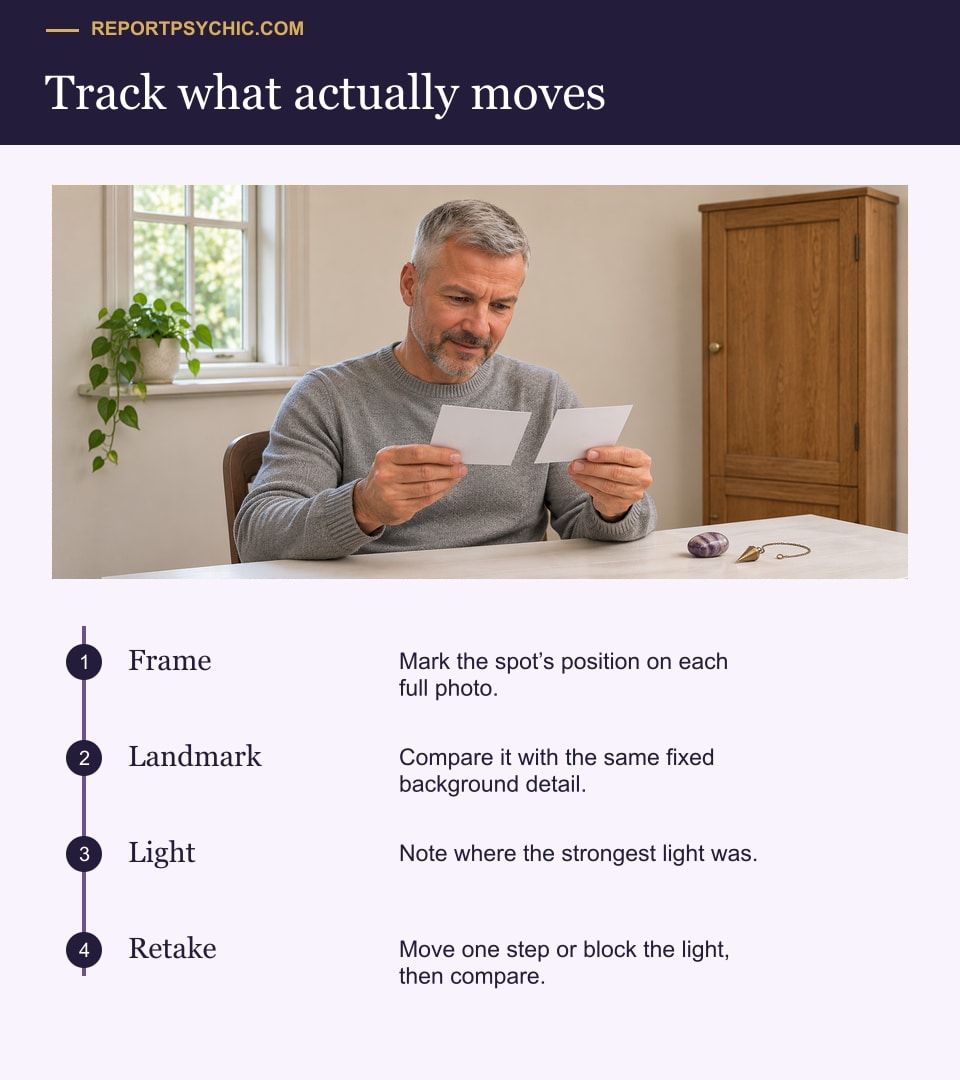
Read the visual guide as text
- Frame. Mark the spot’s position on each full photo.
- Landmark. Compare it with the same fixed background detail.
- Light. Note where the strongest light was.
- Retake. Move one step or block the light, then compare.
A museum window example
Suppose three photos of a friend in a museum plaza show a green disk near one shoulder. In the first two photos, the friend moves but the photographer stays near a shiny doorway. In the third photo, the photographer moves sideways, and the disk follows the apparent direction of the bright window. Review how the spot moves relative to the fixed doorframe. Nikon explains how light reflected inside a camera can produce ghost shapes.
If you can repeat the framing safely, keep the subject still and shade the lens from the side. Then compare a shot with the lens unshaded. Testing one change at a time makes the comparison easier to interpret.

Give the album a stopping point
You may notice the spot more often once you know to look for it. Try comparing a fixed batch of original photos from one event. Include ones where it does not appear. Write down the common conditions, what you checked and which detail is still unclear.
If the pattern feels symbolic, name what it brings to mind. You can keep a personal story while giving yourself permission to stop tracking photographs when the search becomes unsettling.
Frequently asked questions
1. Why does an orb appear beside me in several photos?
Similar framing, lighting and camera position can repeat a reflection or other image effect near the same part of a person.
2. What does a spot in the same place in the frame suggest?
It can point toward an effect tied to the camera, lens, editing or display. Compare original files before deciding.
3. What if the spot moves relative to the background?
Compare the position of the light and the camera across frames. Internal reflections can move as the camera angle changes.
4. How many photos should I compare?
Start with the original and a few frames from the same sequence, including any without the spot.
5. What is a simple way to test for flare?
Keep the subject still and move the camera or shade the lens from an off-frame light. Change one condition per comparison.