


You can believe in psychic guidance and still ask clear questions about price, privacy and conduct. A useful reading should leave room for your choices, including the choice to disagree or stop. No connection, rating or impressive detail removes those rights.
Before you choose a reader
Decide what you want to explore: a relationship question, a life transition or a symbolic tarot reflection. Read the profile for methods, language and what the service includes. Tarot, aura readings and mediumship describe different advertised approaches; none makes a particular outcome certain.
Compare the complete price, the reader’s availability and the support process. Read several specific reviews, looking for descriptions of communication, billing and boundaries. Our review-checking guide explains why star ratings and verified labels cannot establish psychic accuracy.
Choose a private setting for an online conversation, but do not assume that a closed door protects a shared account or visible notifications. Share only the background you are comfortable giving. A reading should not require account passwords, bank access or a partner’s sensitive information.
At a glance
These signs identify concerns to examine, not an automatic verdict about someone’s intent. Stronger pressure or a credible threat may be enough reason to stop safely without further discussion.
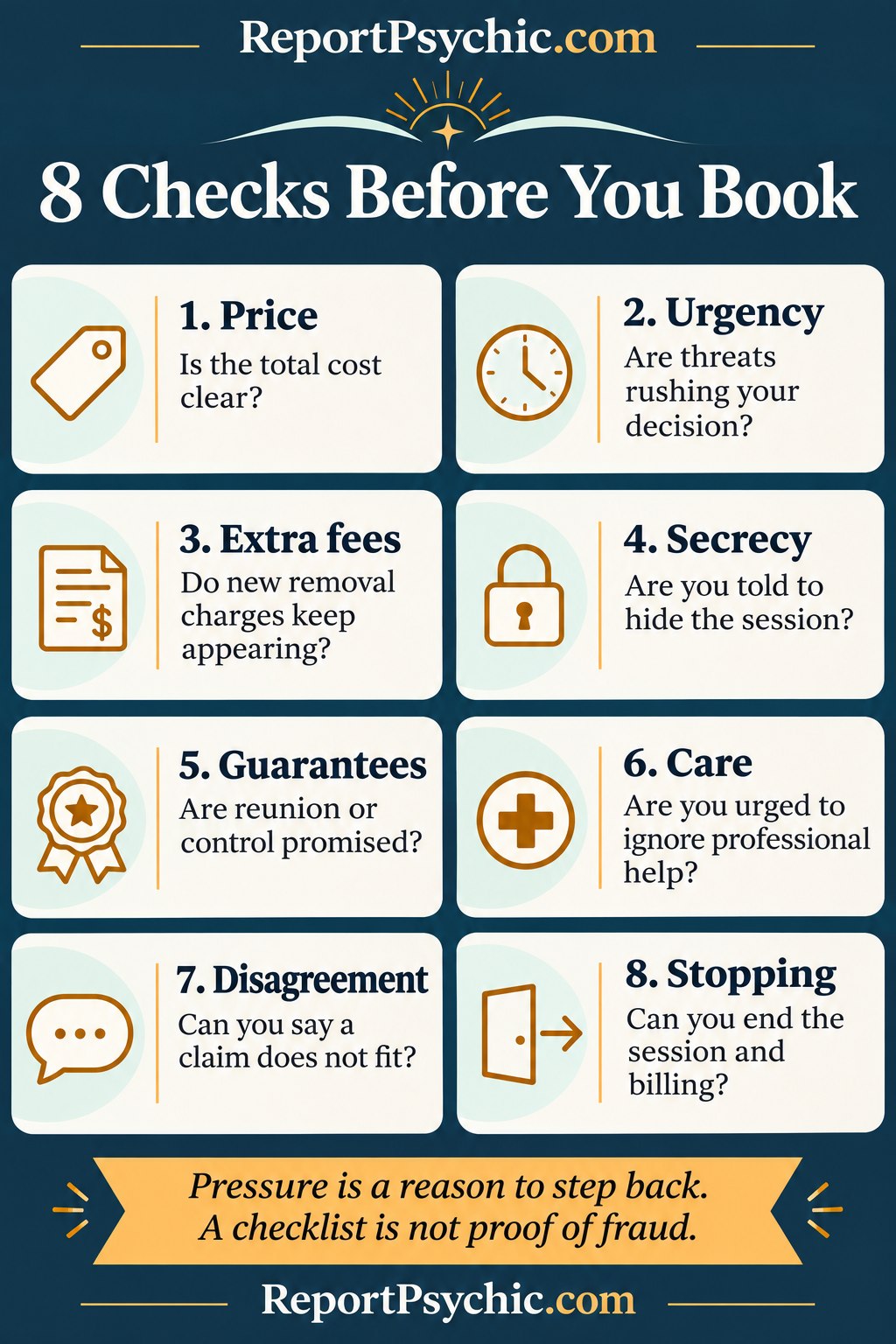
Eight things worth noticing
- Unclear price: extra charges or minimum purchases are not explained.
- Threat-based urgency: you must pay now to prevent harm.
- Escalating removal fees: each supposed solution reveals another costly problem.
- Secrecy: you are discouraged from seeking an outside perspective.
- Guaranteed control over someone else: a reunion or change of feelings is sold as certain.
- Pressure against care: a reading is used to replace appropriate professional assessment or treatment.
- No room for a miss: disagreement is blamed on you or every claim changes to fit.
- Difficulty stopping: the session or billing continues after you try to end it.
Match the response to the concern
Ask for clarification where appropriate. For intimidation, stop and seek support. For a charge dispute, keep the terms, receipts and messages and use official support and payment-provider channels promptly.
Check claims fairly
A vague statement or mistake is not by itself proof of fraud. Keep the exact exchange and distinguish interpretation, service quality and possible misconduct.
Being open does not mean agreeing with everything
You can listen to a spiritual interpretation while keeping track of what fits and what does not. Specific detail can be interesting, but first ask whether it came from information already available, your answers or a flexible statement. An inaccurate or vague reading does not by itself prove deliberate deception; equally, a statement that feels accurate does not justify payment pressure.
Notice discomfort as a reason to pause, then identify the conduct. “The price changed after I declined” is more useful to document than a conclusion about someone’s hidden motives. Our Barnum effect and cold-reading guide explains how a personal impression can arise.

Free before-during-after reading checklist
Before
My question: ____. Total price and stop point: ____. Details I will keep private: ____. Official support route: ____.
During
Is the agreed service being provided? Can I say something does not fit? Are my limits respected? Is any new charge being proposed?
After: Keep the actual claims, misses, receipt and any terms you agreed to. Separate what was meaningful from what was independently confirmed. Choose one practical next step without treating a prediction as a commitment.
If you suspect a scam
Pause further payments and preserve relevant messages and receipts. Contact the service and your payment provider through independently verified official channels promptly. The FTC explains payment-specific steps after a scam; recovery is not guaranteed. Be cautious about a new person asking for an upfront payment to recover your money.
The FTC’s scam guidance also highlights urgency and demands for particular hard-to-reverse payment methods. A belief in spiritual help does not require you to pay under threat. For a credible threat or immediate danger, seek appropriate local support or emergency help.
Frequently asked questions
1. Can I question a psychic even if I believe in readings?
Yes. Belief does not remove your right to clear terms, privacy, disagreement and the freedom to stop.
2. Do warning signs prove someone committed fraud?
Not automatically. They identify conduct to examine. A credible threat or strong pressure may still be enough reason to stop without deciding the person’s intent.
3. What price details should I check?
Confirm the total or per-minute rate, minimum purchases, additional charges, promotional limits and any recurring billing before agreeing.
4. Are curse-removal payments a warning sign?
Threats that harm will occur unless you pay, especially with escalating fees or secrecy, are strong reasons to pause and seek an independent perspective.
5. Are specific details proof of psychic ability?
No. Consider information already available, questions you answered, wording and misses as well as apparent matches.
6. Can my intuition identify a scam with certainty?
An uneasy feeling can prompt a pause, but it does not establish intent. Focus on observable conduct and independently checkable information.
7. How useful are online reviews?
Specific reviews may describe service and billing experiences. Ratings, popularity and verified labels cannot guarantee your result.
8. Must I provide extensive personal information?
Share only what is necessary and comfortable. Do not provide passwords, bank access or another person’s sensitive details to obtain a reading.
9. Can I tell the reader that something does not fit?
Yes. You can disagree or ask for clarification without being blamed for the result or pressured to buy more time.
10. Does a positive prediction mean a reading is trustworthy?
No. A reassuring statement still needs the same attention to terms, conduct and evidence as an uncomfortable one.
11. Can a reader guarantee a partner will return?
No reader can provide another person’s consent or guarantee their choices. Treat guaranteed reunions and control over others as warning signs.
12. Is an online reading automatically less genuine than an in-person one?
The format alone cannot establish ability or honesty. Check the same conduct, privacy, claims and billing issues in either setting.
13. What should I keep after a disputed session?
Preserve the advertised terms, receipt, dates, actual messages and the resolution you requested. Use factual descriptions rather than assumptions about intent.
14. Who should I contact about a payment problem?
Use the platform’s official support and your payment provider promptly. Ask what options apply to the payment method and circumstances; do not assume a refund is guaranteed.
15. Should I pay someone who promises to recover my money?
Be cautious about unsolicited recovery offers, especially upfront fees or requests for sensitive details. Verify official help independently.
This article provides some great insights into identifying fraudulent astrologers. It’s crucial for consumers to be informed about what to look out for, especially in such an unregulated field like astrology. Knowledge is power!
‘If they could predict the lottery, they’d win it themselves.’ That’s rich coming from someone writing an article on astrology! Why don’t we just let people enjoy their beliefs without throwing shade?
‘Astrologers who can’t spell? Shocking!’ This entire article reads like a poorly written horoscope—so vague yet so specific at once. What’s next? Telling us to avoid psychics with messy hair?
“The Psychic or Clairvoyant Astrologer” sounds like a bad superhero movie! Honestly, this whole piece had me chuckling—especially picturing a ‘psychic’ reading off a website during parties. What’s next, fortune cookies giving better advice?
“No astrologer can fix your life with no effort on your part.” Wise words! This article serves as a reminder that while astrology can provide guidance, personal responsibility is key in making positive changes in our lives.
Honestly, I think the whole astrology thing is a load of nonsense. If people would just focus on their own lives instead of seeking help from these so-called experts, they’d save themselves a lot of heartache and cash.
I absolutely loved this article! It’s refreshing to see someone highlight the good astrologers while also warning us about the frauds. Astrology can be a beautiful tool for self-discovery, and this post really helps us navigate through the noise.
While I appreciate the cautionary tone here, it feels overly critical of all astrologers. Not every practitioner fits into these negative categories! Many people find genuine value in astrology that can’t be dismissed so easily.