

Quick guide
A reading goes better when you have done three small things beforehand: chosen a reader you can check, written down what you actually want to ask, and decided in advance how much weight you will give the answers. Most disappointing readings, and nearly all costly ones, come from skipping one of those steps. This guide covers what to do before, during and after a session, what a reasonable reader will and will not promise, and the questions that get useful answers.
Before you book: check the reader, not the promise
The first decision is who you are paying, and it deserves ten minutes of ordinary research. Read the reader’s profile or website and look for a stated price, a stated session length and a refund or satisfaction policy. Look at reviews with the same scepticism you would apply to any online service: a wall of five-star one-liners is less informative than a mix of detailed comments, and platforms that label verified purchases are easier to trust. Our guide to verifying psychic reviews before booking shows what to look for, and how the industry’s transparency tools work explains what posted ratings can and cannot tell you.
Some claims should end your research on the spot. A reader who advertises guaranteed outcomes, lists “curse removal” or “spell breaking” as a service, or refuses to state a price is showing you their business model. The red flags to watch out for are consistent across phone, chat and in-person readings, and the curse-removal script in particular has cost people tens of thousands of dollars.
One more practical check: know which format you are booking. Phone and chat readings on platforms usually bill per minute with a visible timer; in-person sessions are usually flat-rate. Face-to-face readings have their own considerations, and if you are looking specifically for a medium rather than a general reader, choosing a psychic medium and getting ready for a medium reading cover the differences.
The reading, in four stages
- Choose Posted price, session length, refund policy and reviews you can check. No guarantees, no curse services.
- Prepare Two or three specific questions written down. Decide your budget and your stop time before you start.
- During Answer briefly, notice how much the reader asks versus tells, and steer back to your questions.
- After Note what was specific and what was general. Sleep on any decision. Check the bill against the timer.
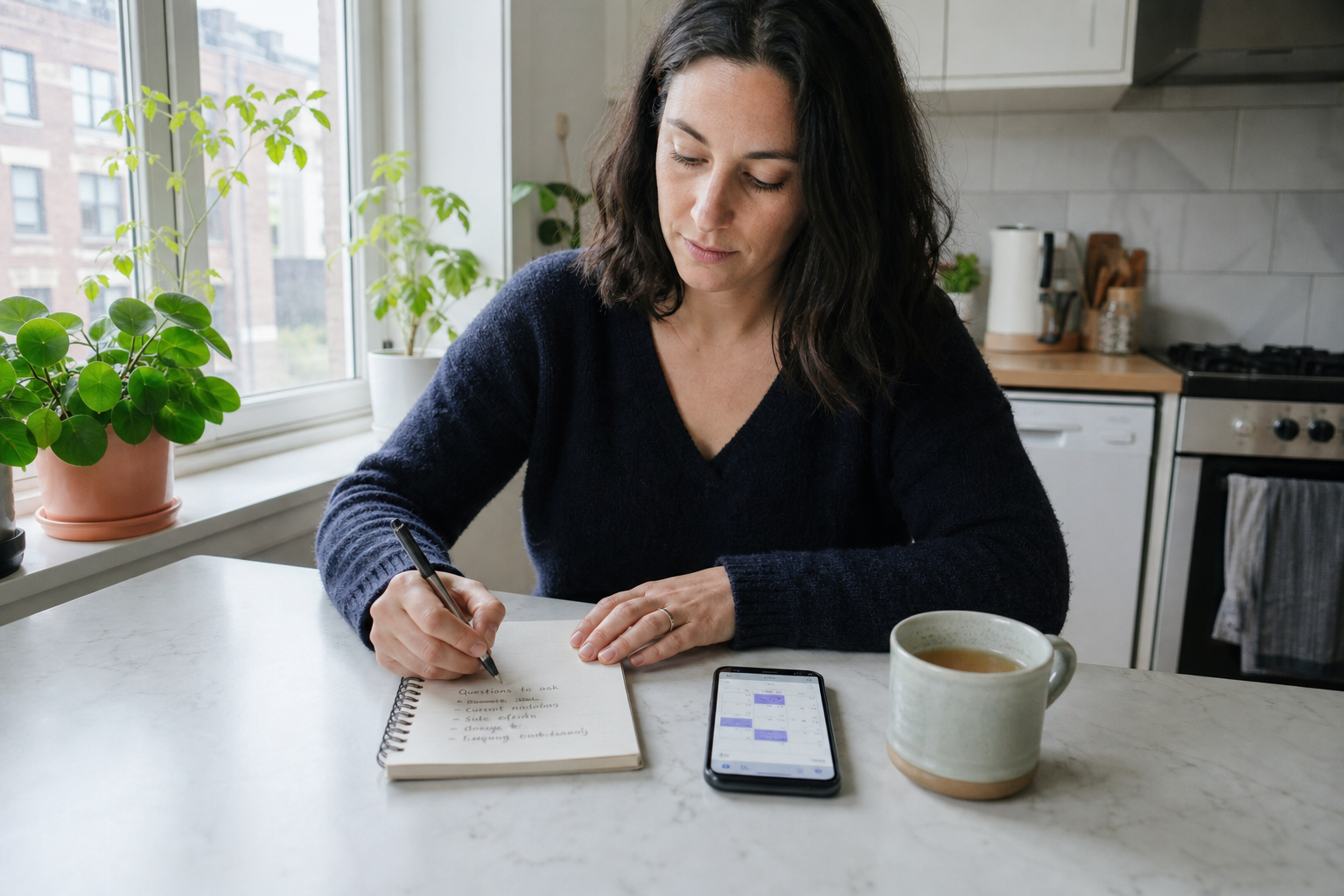
The four stages apply to phone, chat and in-person readings alike. The single most useful habit is writing your questions down first.
What to prepare: questions that can actually be answered
Readers work with what you bring. A vague opening (“tell me what you see”) invites vague, widely applicable statements, and it makes it hard to judge afterwards whether anything specific was said at all. Specific questions get specific answers, and they also make it obvious when a reader is dodging. A good rule is two or three questions, each about a situation you are actually facing, phrased so that the answer would help you decide something.
Questions that work
“I’ve been offered a job in another city. What should I weigh up that I might be missing?” “My relationship with my sister has been strained since the funeral. What would help?” “I keep putting off starting my own business. What is really holding me back?”
Questions that don’t
“Will I get the job?” “Is he going to leave her for me?” “When will I die?” “Should I stop taking my medication?” Yes-or-no predictions about other people’s choices and any question about health, legal or financial decisions that belong with a professional.
For a longer list of what to ask and what to avoid, see questions to ask your psychic and ten things not to ask a tarot reader. If you are booking because of a breakup, getting a reading after a breakup covers how to keep it useful rather than a way of staying stuck.
Set your budget and your stop time first
Per-minute billing is designed to make time disappear. Before a phone or chat session starts, decide the maximum you will spend and set a timer on your own phone. Twenty to thirty minutes is enough for two or three questions with a competent reader. If the reader says the answer needs “more time” or “a follow-up”, that is a request for more money, and you can decline it. For in-person sessions, confirm the price and what it includes before you sit down, and pay with a method that leaves a record. Premium-priced services are not exempt from any of this.
During the reading: what to watch for
You do not need to test a reader or give one-word answers to catch them out; that makes for a wasted session. But it is worth noticing a few things while it happens.
| What you notice | What it usually means | What to do |
|---|---|---|
| The reader asks many questions and then repeats your answers back as insight | Information is coming from you, not to you | Answer briefly. Ask “what are you getting on that?” before you explain |
| Statements that would fit almost anyone (“you’ve been through a lot lately”) | General statements that feel personal; the technique is well documented | Ask for something specific to your question |
| A pivot from your question to “blocks”, “negativity” or someone “working against you” | The setup for a paid removal | End the session. See our guide to checking a psychic’s claims |
| The reader tells you what to do about health, medication, a lawsuit or your money | Outside any reader’s competence | Note it, and take those decisions to the relevant professional |
| Clear, specific comments tied to your question, with room for you to disagree | A reader doing the job well | Take notes; this is the material worth reflecting on |
If you want to understand the mechanics of how a reading can feel accurate without any special ability, the cold-reading guide explains the techniques. Knowing them does not stop you enjoying a reading; it stops you being charged for a second one on false pretences.
After the reading: what to do with what you heard
- Write down the specifics within an hour. Memory quickly reshapes a session into “they knew things”. Note what was said that could only apply to you, and what was general.
- Separate observation from prediction. “You seem torn about the move” is an observation you can use. “You will move in March” is a prediction; treat it as one possibility, not a schedule.
- Sleep on any decision. Nothing said in a reading needs acting on that day. If it still seems right in the morning, it was probably already your own view.
- Check the bill. Compare the minutes charged with your own timer. Dispute discrepancies with the platform first; how billing complaints are handled walks through the process on one large platform.
- Decide whether you would rebook, and why. A reading that left you calmer and clearer earned a second one. A reading that left you anxious or dependent did not, however accurate it felt.
What a reading can and cannot do
The honest version is simple. A good reading is a structured conversation with someone skilled at listening, noticing and asking the right questions, using cards, symbols or intuition as a framework. Many people find that useful for thinking through a decision or a relationship, in the same way a long talk with a perceptive friend can be. There is no controlled evidence that readers can see the future or know facts about you they were not given, and a reader who insists otherwise is either mistaken or selling something. Tarot interpretations, aura readings and mediumship are interpretive frameworks, not facts about the world, and the useful ones are offered that way.
What that means in practice: use a reading for reflection, perspective and the questions it raises; do not use it in place of a doctor, a lawyer, a financial adviser or a therapist, and do not let anyone tell you that your problems come from a curse. The traits of a good reader all come back to this: they leave you more capable of running your own life, not less.
Key takeaways
- Check price, session length, refund policy and reviews before booking; walk away from guarantees and curse services.
- Write two or three specific questions. Vague openings get vague answers.
- Set a budget and a timer before a per-minute session starts.
- Notice whether information is flowing from you or to you, and end any session that pivots to “blocks” needing paid removal.
- Write down the specifics afterwards, sleep on decisions, and keep health, legal and money decisions with professionals.
Frequently asked questions
1. How should I prepare for my first psychic reading?
Choose a reader with a posted price and checkable reviews, write down two or three specific questions, decide your budget, and set a timer if the session is billed per minute. That is all the preparation a first reading needs.
2. What questions should I ask a psychic?
Open questions about situations you are actually facing: what to weigh up in a decision, what might be affecting a relationship, what is holding you back. They give the reader something to work with and give you something usable afterwards.
3. What questions should I avoid?
Yes-or-no predictions about other people’s choices, anything about health, medication, legal cases or investments, and questions that invite a reader to frighten you, such as whether someone has cursed you.
4. How long should a psychic reading be?
Twenty to thirty minutes covers two or three questions well. Longer sessions rarely add much and, on per-minute platforms, mostly add cost.
5. Should I tell the psychic anything about myself first?
Give your question and the context it needs, and nothing more. You are not trying to catch anyone out, but the less you volunteer, the easier it is to judge afterwards whether anything specific was offered.
6. Is it better to have a reading by phone, chat or in person?
None is more accurate than the others. Phone and chat readings are cheaper to sample and easier to end; in-person sessions suit people who want a longer conversation. Judge the reader, not the medium.
7. How much does a psychic reading cost?
Platform readings typically bill per minute, often with introductory rates for new customers; independent readers usually charge a flat fee per session. Any reader who will not state a price before starting is a reader to avoid.
8. What if the reader tells me I am cursed?
End the session and pay nothing further. The curse claim followed by paid removal is the most common psychic fraud, and it escalates. Our guide to curse-removal scams explains the pattern and what to do if you have already paid.
9. Can a psychic really predict my future?
There is no controlled evidence that anyone can. Treat predictions as possibilities to think about, not schedules. The value of a reading, where there is one, is in the reflection it prompts.
10. Why did the reading feel so accurate?
Readers, honest and otherwise, use general statements that most people recognise in themselves, and they pick up on your reactions. That is not necessarily dishonest, but it is worth knowing. Our guide to cold reading explains how it works.
11. Should I record the reading?
If the reader agrees, yes. A recording makes it much easier to separate what was specific from what was general once the session’s atmosphere has worn off.
12. What should I do if I disagree with what the reader says?
Say so. A good reader will adjust or ask a better question. A reader who insists you are “blocking” or “not open” when you disagree is protecting their statement, not helping you.
13. How often should I get a reading?
Rarely enough that you are making your own decisions between sessions. If you are booking weekly, or before every choice, the reading has become a dependency rather than a tool, and a reader who encourages that is not acting in your interest.
14. Can I ask about someone else, such as a partner or an ex?
You can ask about your own situation with that person and what you might do. Asking a reader to report on another adult’s private feelings or intentions produces guesses at best, and it is where many people are told what they want to hear at length.
15. What should I do if I was overcharged?
Compare the minutes billed with your own timer, contact the platform’s support with the session details, and if that fails, dispute the charge with your card issuer. Keep screenshots of the session and the receipt.
16. Is a free reading a good way to try a psychic?
Short introductory offers on platforms are fine as a sample. A “free” reading that ends with alarming news and a fee to fix it is the opening of a scam, not a sample.
17. What is the difference between a psychic and a medium?
A medium claims to relay messages from people who have died; a psychic reading is about your own life and questions. The preparation is similar, but a medium reading has some extra considerations covered in our guide to getting ready for a medium reading.
18. Should I make a big decision based on a reading?
No. Use the reading to notice what you think and feel about the decision, then make it with the information and advice the decision actually needs. If the reading confirms what you already believed, that is useful; if it contradicts your judgement, your judgement should win.
19. What if I get upset during a reading?
You can stop at any time; you do not owe the reader the rest of the session. If the upset is about grief, loss or anxiety that keeps returning, a counsellor is a better next step than another reading.
20. How do I know if a reader is genuine?
There is no test that proves psychic ability; there are only signs of honest practice: a stated price, no guarantees, no fear, no pressure to rebook, and answers that stay on your question. Five traits of a good reader lists what to look for.
Already had a reading that went wrong?
If a reader frightened you, overcharged you or asked for money to remove a curse, our guide explains what to do next, including refunds and where to report.
Evidence check: claims in this article about cold reading, review reliability and scam patterns are drawn from consumer-protection guidance and published research on how readings feel accurate; the FTC’s guidance on what to do if you were scammed and its endorsement guides on reviews are the primary sources. Psychic readings, tarot and mediumship are interpretive practices; nothing in this guide is medical, legal or financial advice.

‘Empower your life’? More like empower their bank account! The truth is, while some might find clarity in these sessions, it’s essential to approach them with caution and not let them control your decisions.
‘80% accuracy’? That sounds like an excuse for when they get it wrong! If they really had powers, shouldn’t they be able to predict lottery numbers or something useful? Just saying.
I absolutely loved this article! It perfectly captures the essence of what psychic readings can be. As someone who has benefited from them, I agree that having an open mind and being prepared makes all the difference. Thanks for sharing!
This article provides valuable insights into the world of psychic readings. It’s crucial to recognize that these experiences are not infallible, and doing your research beforehand can make a significant difference in your experience.
‘Psychic readings: because who needs a crystal ball when you have a medium with a fancy website?’ 😂 Seriously though, this article is an interesting read if you’re into this kind of thing!
While I appreciate the author’s perspective, I must argue that many people use psychics as a means of escapism rather than empowerment. It’s important to critically evaluate how much weight we give to such predictions in our lives.
Honestly, this whole idea of psychic readings seems like a farce to me. How can anyone claim to predict the future? It’s just smoke and mirrors, preying on the vulnerable. This article doesn’t change my mind one bit.
‘Bring specific topics’? Sounds like I’m going in for an interview instead of a mystical experience! What’s next? Do I need to prepare my resume before seeing a psychic? Hilarious!