

Quick guide
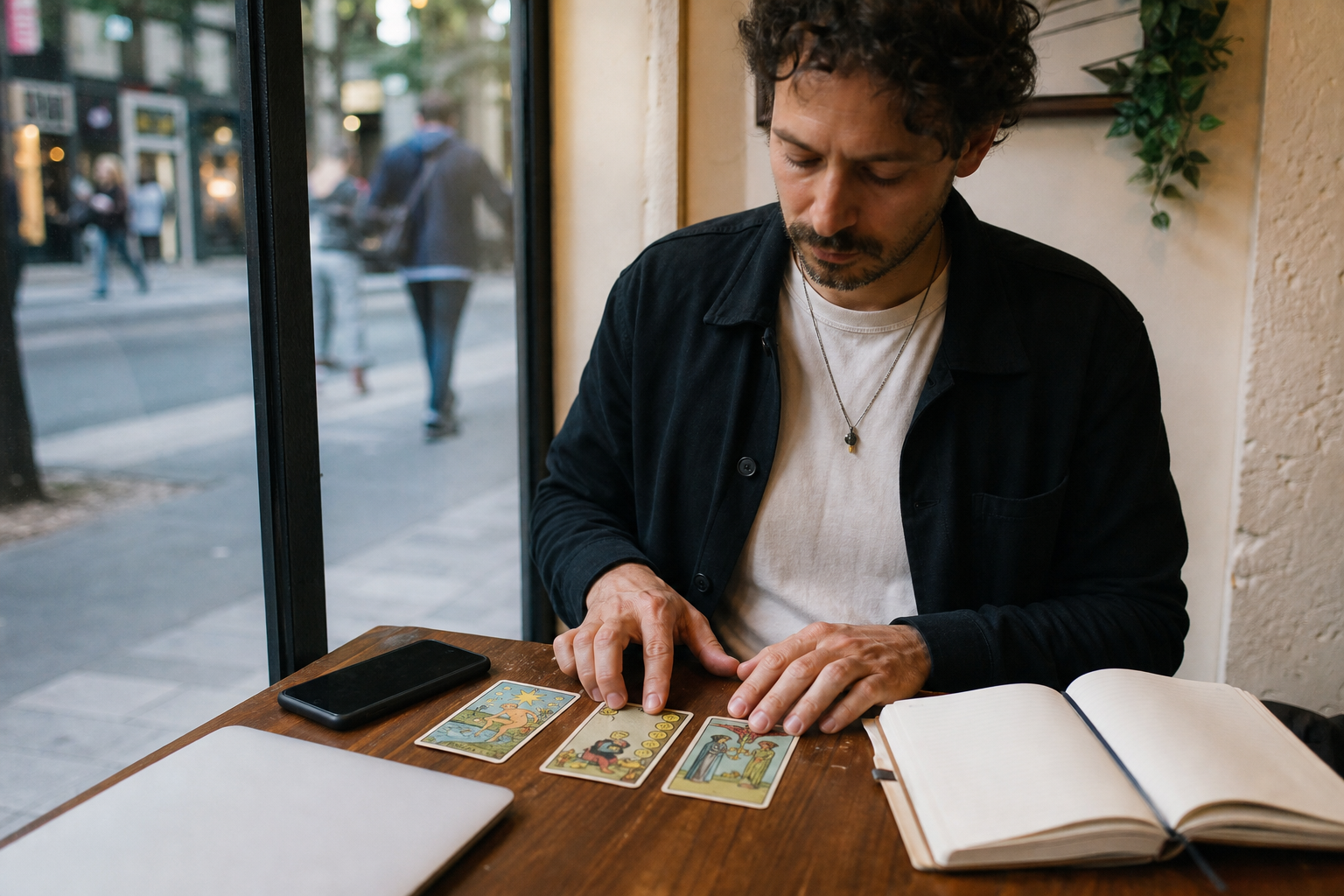
Tarot imagery can offer a prompt for journaling or discussion. A reflective spread helps you consider a question; it should not be treated as proof of a future event, a diagnosis or someone else’s private feelings.
Choose a question about your choices
Try “What should I consider about this move?” rather than “Which choice guarantees success?” Keep the situation specific and distinguish the facts you know from the assumptions you are exploring.
You do not need to know every card meaning or perform a ritual. Use a deck you can comfortably see or handle, or adapt the exercise with ordinary images or written prompts.
Situation → assumption → next step
- SituationWhat does this image bring to mind about the question?
- AssumptionWhat am I taking for granted?
- Next stepWhat could I check, ask or try outside the reading?
Write before reaching for certainty
For each image, note what caught your attention and why it might relate. Then read a guide if you want another perspective. A meaning that does not fit can remain a meaning that does not fit; you do not need to invent an event to match it.
End with a manageable action or an unanswered question, not a command from the cards. A factual issue still needs factual information.
Handle unsettling cards gently
A dramatic image is not an announcement that disaster must happen. Ask about its symbolism and decide whether that interpretation is useful. You may put a card aside or stop the exercise. You do not need to pay to remove a consequence.
Notice when the practice becomes repetitive reassurance
If you keep drawing until you get a preferred answer, pause and ask what information or support is missing. A deck cannot supply another person’s consent or resolve every uncertainty. Repeated checking may leave you less able to decide.
Tarot is not a substitute for mental-health care, medical assessment or regulated legal and financial advice. Seek qualified support when distress persists or affects daily life.
If you prefer a paid reading
Ask about the approach, full price, duration, privacy and stopping process. You can disagree, decline touch or questions and refuse further purchases. A meaningful discussion does not verify every claim the reader makes.
Frequently asked questions
Do I need to memorize card meanings?
No. You can begin with what an image brings to mind, then consult a guide for another perspective if you wish.
What is a useful three-card spread?
Try situation, assumption and next step. Treat each card as a prompt rather than a factual verdict.
Does a frightening card predict harm?
Do not treat an image as proof that harm will happen. You can question the interpretation, put the card aside or stop.
Should I keep drawing until I feel reassured?
Pause if you are repeatedly checking for a preferred answer. Consider what information, decision or support is missing outside the reading.
Can tarot answer health or legal questions?
It should not replace appropriately qualified advice or assessment. Use relevant professionals for those decisions.
Can I decline a reader’s interpretation?
Yes. You can disagree, decline a topic or stop without buying another service.
If only my tarot deck had an ‘instant success’ card! I’d pull that one every time and avoid all my problems!
Maybe we should start a tarot-themed comedy night—’The Cards Say This Is Going Nowhere!’
Right?! And if it had a ‘bad decision’ card, I’d probably pull that one too!
Honestly, I find this whole tarot reading concept a bit silly. How can a few cards really provide guidance? It seems like a lot of wishful thinking rather than practical advice.
While some may dismiss tarot as mere superstition, it’s worth noting that its psychological benefits can be profound. Engaging with tarot can promote self-reflection and insight. Just make sure to approach it critically.
But isn’t relying on cards for guidance just another form of escapism? People should seek real solutions instead of turning to mystical readings.
That’s an interesting perspective! I think the self-reflection aspect is crucial, especially in times of uncertainty.
‘Your future can feel better’ sounds nice but isn’t that subjective? Isn’t it more about the choices we make rather than what some cards say?
I absolutely loved this article! Tarot reading has always intrigued me, and the way you explained the Three Card spread made it sound so accessible. I can’t wait to try it myself!
This article really speaks to me! I’ve always been curious about tarot and how people find guidance through it. It’s comforting to know there’s a tool for self-exploration and understanding.
Comforting, yes, but let’s not forget that no amount of card shuffling can replace hard work and personal responsibility!
‘Getting advice from cards’ sounds so ridiculous! What’s next? Seeking life tips from fortune cookies? Let’s focus on real-world solutions instead!
‘Fortune cookies are actually very wise!’ said no one ever who wanted genuine advice.
‘Tarot cards will tell you it is time to move’? Or maybe they just want you to shuffle them more! If only they could help with my procrastination too!