

Quick guide
Chakra healing is the practice of “balancing” seven energy centres said to run from the base of the spine to the crown of the head, usually through a practitioner’s hands, crystals, sound, breathing or guided visualisation. The chakra system comes from Indian tantric traditions and was reworked into its modern seven-colour form in the twentieth century. As anatomy, chakras do not exist; no instrument has ever detected one, and “blockages” cannot be measured. As a framework for reflection (am I grounded, am I speaking up, am I letting people close?) the system is coherent and some people find it useful. A session is a relaxing hour with an attentive person, and that has value; what it cannot do is treat illness, and what you should not pay for is escalating “clearing”.
Where the system comes from
Chakra (Sanskrit for “wheel”) appears in Hindu and Buddhist tantric texts from roughly the eighth century onward, where different traditions describe different numbers of centres used in meditation and ritual. The version most people know today, seven chakras each with a colour, a location, a set of organs and a psychological theme, was assembled in the twentieth century by Western writers who combined the Indian sources with Theosophy, colour theory and, later, popular psychology. The colours in particular (red root, orange sacral, yellow solar plexus, green heart, blue throat, indigo brow, violet crown) date from the 1970s. None of this makes the framework worthless; it does mean claims about its ancient precision are not accurate.
The seven chakras as a reflection framework
- Root and sacral Safety, money, body, pleasure. “Am I secure? Am I enjoying anything?”
- Solar plexus and heart Confidence, will, love, grief. “Do I feel capable? Am I letting people close?”
- Throat Expression. “Am I saying what I mean?”
- Brow and crown Attention, meaning. “Am I noticing what I notice? Does my life connect to anything larger?”
Read this way, “my heart chakra is blocked” means “I have been holding people at a distance since the bereavement”, which is true, useful and free to act on.
What a session involves
| Method | What happens | What you get |
|---|---|---|
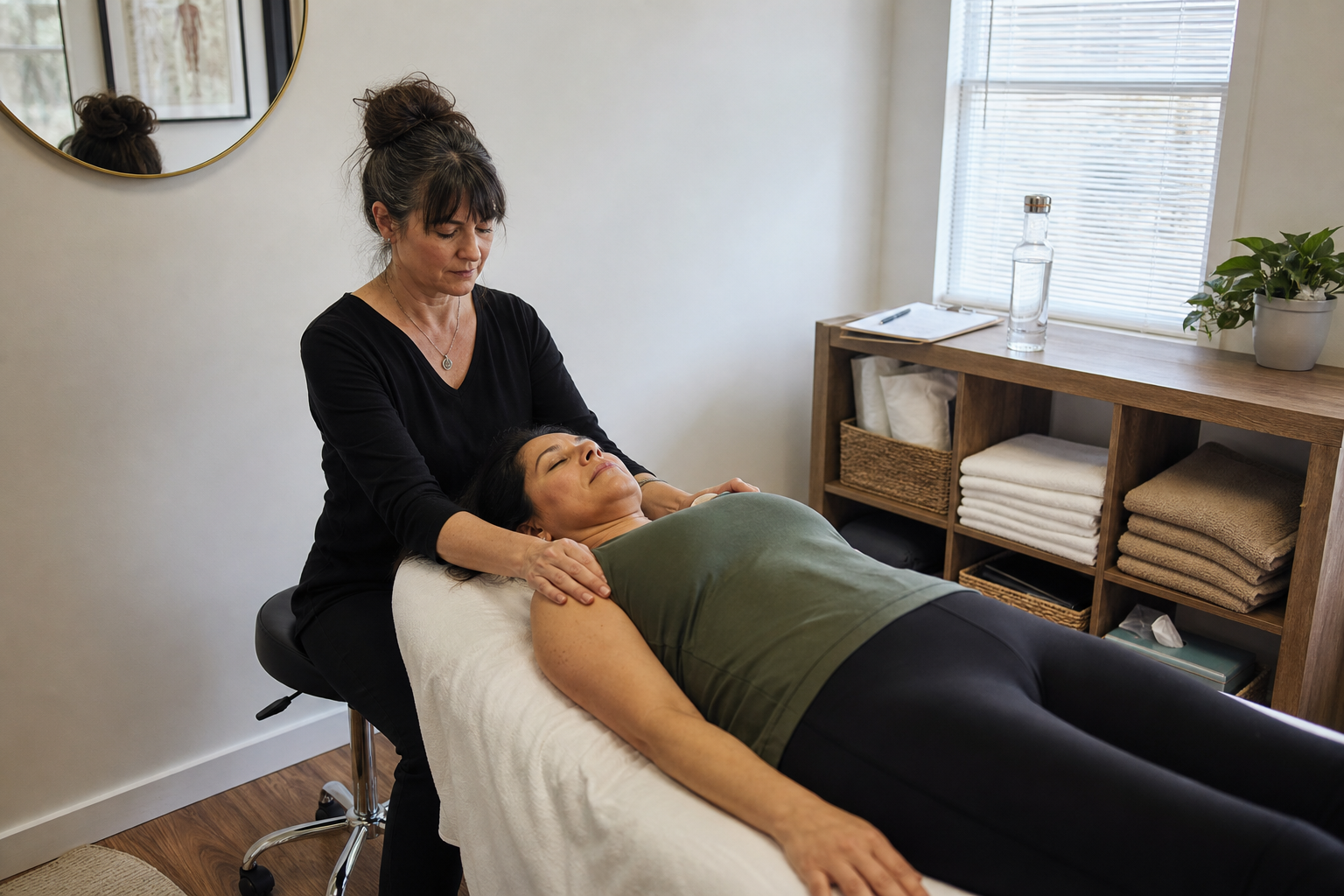
| Hands-on or hands-near (Reiki-style) | You lie clothed on a table; the practitioner holds hands over each centre for a few minutes | Deep relaxation from stillness and attention. The NIH’s summary of Reiki research finds no effect beyond that |
| Crystals on the body | Stones matched to each chakra’s colour placed along the body | The same relaxation; the stones are decorative |
| Sound (bowls, tuning forks, chanting) | Tones played near the body or sung | Pleasant; slow sound can lower arousal |
| Guided visualisation | You picture each centre as a spinning wheel of colour, clearing and brightening | A structured meditation; reasonable evidence for meditation reducing stress |
| Breathing and yoga | Postures and breath patterns assigned to each centre | Real benefits of movement and slow breathing; see the NIH on yoga |
| Pendulum “diagnosis” | A pendulum swung over each centre to read its state | The ideomotor effect: the practitioner’s hand moves with expectation. Not a measurement |
What balancing can and cannot do
Reasonable to expect
An hour of calm. A prompt to notice which area of life you have been neglecting. Better sleep that night. A vocabulary for talking about how you feel. For people who enjoy ritual, a satisfying one.
Not reasonable
Diagnosis of anything. Treatment of illness, physical or mental. Removal of “blocks” that could be measured before and after. Any effect that depends on the practitioner’s hands doing something to a field, because there is no field.
The earlier version of this article said chakras carry electromagnetic charges, spin clockwise or anticlockwise, and are fed by currents from the earth and the universe. None of that is measurable, and presenting it as physics is what lets sessions be sold as treatment. If you have symptoms, see a doctor; a session can sit alongside care, never in place of it.
How to use the practice without being sold to
- Go for relaxation and reflection, and say so. A practitioner who is comfortable with that is the one to choose.
- Pay a flat, posted price for a single session. No packages of “deep clearings”, no escalating tiers.
- Do the reflection yourself afterwards. Which centre’s question landed? What one thing would address it this week?
- Keep the free versions. Guided chakra meditations, breathing and yoga cost nothing and give most of the benefit. Poses to boost energy flow is a decent short sequence.
- Leave at the first sign of fear. “Your root chakra is dangerously blocked”, “there is an attachment in your field”, “you will need several sessions” are the removal script in wellness vocabulary.
For how the chakra vocabulary connects to auras, see chakras and auras working together; for the stones, crystals and the spiritual journey gives the honest version.
Key takeaways
- The seven-colour chakra system is a twentieth-century synthesis of Indian tantric ideas, Theosophy and colour theory; as anatomy it does not exist.
- As a reflection framework (safety, pleasure, confidence, love, expression, attention, meaning) it is coherent and usable.
- A session delivers relaxation and attention; the NIH finds no effect of energy healing beyond that.
- Balancing cannot diagnose or treat anything. Symptoms go to a doctor.
- Pay flat prices for single sessions, do the reflection yourself, keep the free practices, and leave at the first sign of fear.
Frequently asked questions
1. What is chakra healing?
A practice of “balancing” seven energy centres said to run along the spine, using hands, crystals, sound, breathing or visualisation. It delivers relaxation and a framework for reflection; it does not act on any measurable energy.
2. Are chakras real?
As anatomy, no; no instrument detects them. As a traditional map for meditation and a modern framework for reflecting on areas of life, yes, in the sense that the framework is coherent and people use it.
3. What are the seven chakras?
Root (base of spine), sacral (lower abdomen), solar plexus, heart, throat, brow (third eye) and crown, assigned red, orange, yellow, green, blue, indigo and violet in the modern system.
4. What does a blocked chakra mean?
In the vocabulary, that the energy at that centre is constricted. In practice, that the area of life it stands for (safety, pleasure, confidence, love, expression, attention, meaning) has been neglected or hurt. The second reading is the useful one.
5. What happens in a chakra healing session?
Usually you lie clothed on a table while a practitioner holds hands over each centre, sometimes with crystals or sound. Sessions last thirty to sixty minutes and are relaxing.
6. Does chakra healing work?
For relaxation, yes. For treating illness, no; the NIH’s review of Reiki and similar energy practices finds no effect beyond relaxation. For reflection, it works as well as any framework you take seriously.
7. Can chakra healing diagnose illness?
No. Pendulums, hand-scanning and intuition do not measure anything. Symptoms need a doctor.
8. How much should a session cost?
Roughly what a massage costs in your area, flat-rate, for a single session. Packages of “clearings” and escalating tiers are a sign to leave.
9. Can I balance my chakras myself?
Yes, and for free: a guided chakra meditation, slow breathing, yoga, and honest reflection on the seven questions. This gives most of what a session gives.
10. Where does the chakra system come from?
Indian tantric traditions from around the eighth century, with varying numbers of centres. The seven-colour version was assembled by Western writers in the twentieth century.
11. Do crystals help balance chakras?
Stones placed on the body add colour and ritual to a session; they do not act on anything. Enjoy them as objects.
12. Is chakra healing safe?
The practice itself is harmless. The risks are financial (escalating packages) and medical (using it instead of treatment). A practitioner who encourages you to see a doctor is a safe one.
13. What is the difference between chakra healing and Reiki?
Reiki is a Japanese hands-on relaxation practice; chakra healing uses the Indian-derived centre map. Many practitioners combine them. Both deliver relaxation and neither acts on a measurable field.
14. Which chakra should I work on?
Read the seven questions and notice which one you flinch at. That is the area of life to attend to this month, and you can attend to it without any session.
15. A practitioner said my chakra was dangerously blocked. What now?
Treat it as a sales line. Blockages cannot be measured, so “dangerous” cannot be assessed. If it came with an offer of further sessions, see how the removal script works.
16. Can chakra work help anxiety or depression?
Relaxation and reflection can help alongside treatment, and meditation has reasonable evidence for reducing stress. Neither replaces a doctor or therapist for anxiety or depression.
Prefer the free version?
A short standing sequence of movement and breathing, described honestly, that gives most of what an energy session gives.
Evidence check: statements about energy healing follow the NIH’s summaries of Reiki, yoga and meditation; the history follows standard scholarship on the modern chakra system. Chakra healing is a relaxation and reflection practice; nothing here is medical advice.
‘Chakras and philosophical debates’—sounds like a Saturday night at my place with friends arguing over pizza toppings! Seriously though, does anyone have tips on how not to get stuck in energy blockages?
Or maybe just take a nap? Napping definitely heals everything; it’s scientifically proven—by me!
Just avoid negative vibes like they’re onions on a pizza! Who needs that aroma ruining your good time?
Honestly, I find this whole chakra healing concept to be quite ridiculous. How can anyone believe that balancing energy points in the body can actually influence health? It’s all just pseudoscience and wishful thinking.
‘Electromagnetic charges from experiences’? Fascinating! This concept really ties together science and spirituality in a unique way that could change how we view our interactions with the world!
‘Mind over matter’? That phrase is thrown around too casually here. Just because something sounds philosophical doesn’t mean it’s true. If we really want to improve our health, we should rely on proven methods instead of mystical concepts.
This article provides a thorough overview of chakra healing, but it could benefit from some scientific backing. While the ideas are fascinating, linking them to empirical evidence would enhance credibility and encourage more people to consider these practices.
I absolutely loved this article! The way it breaks down the complexities of chakras into understandable segments is commendable. It makes me want to explore chakra healing more seriously. Thanks for sharing!
‘Chakra healing is important’—sure, right after I finish my yoga session with my pet goldfish! Honestly, this sounds like a spa day’s marketing pitch disguised as ancient wisdom.
‘Goldfish yoga’ would probably be an instant hit! Who knew balance could involve aquatic pets? Next thing you know, they’ll start offering chakra massages for cats!
‘Healing your chakras’? Sounds like a fun way to spend an afternoon—right up there with counting clouds or waiting for paint to dry! Really?
‘Daily experiences influence chakras’—that’s an intriguing perspective! I wonder how our interactions affect energy flow in practice. Maybe we need more awareness of our emotional states in everyday life.