

Quick guide
Tarot is a deck of seventy-eight pictures, each carrying a cluster of meanings, that you lay out in response to a question. Used for reflection, it works the way a good journaling prompt works: the picture gives you something to think with, and the thinking is yours. Used for prediction, it fails, because the cards do not know anything. This guide gives a three-card method you can use tonight, explains why it helps when it helps, and marks the ways it goes wrong: taking cards literally, asking about other people, reading compulsively, and letting a reader turn the cards into fear.
What tarot is, and what it is not
The deck has twenty-two major arcana (the Fool, the Tower, the Star and so on) and fifty-six minor cards in four suits. Each card has a range of traditional meanings, and the Rider-Waite images most people know were drawn in 1909 by Pamela Colman Smith. The cards were designed for a game and adopted for fortune-telling in the eighteenth century; there is no evidence that a shuffled deck can foresee anything, and readers who are honest say so. What the cards can do is prompt. Turn over the Eight of Pentacles (a craftsman at his bench) with a question about work in mind, and you will find yourself thinking about patience and practice. That thought was available to you already; the card made you have it. For the case that this is all that is happening in most readings, honest and otherwise, see how to check a psychic’s claims.
A three-card reading for reflection
- Question One real situation, phrased as “what” or “how”: “What am I not seeing about this job decision?”
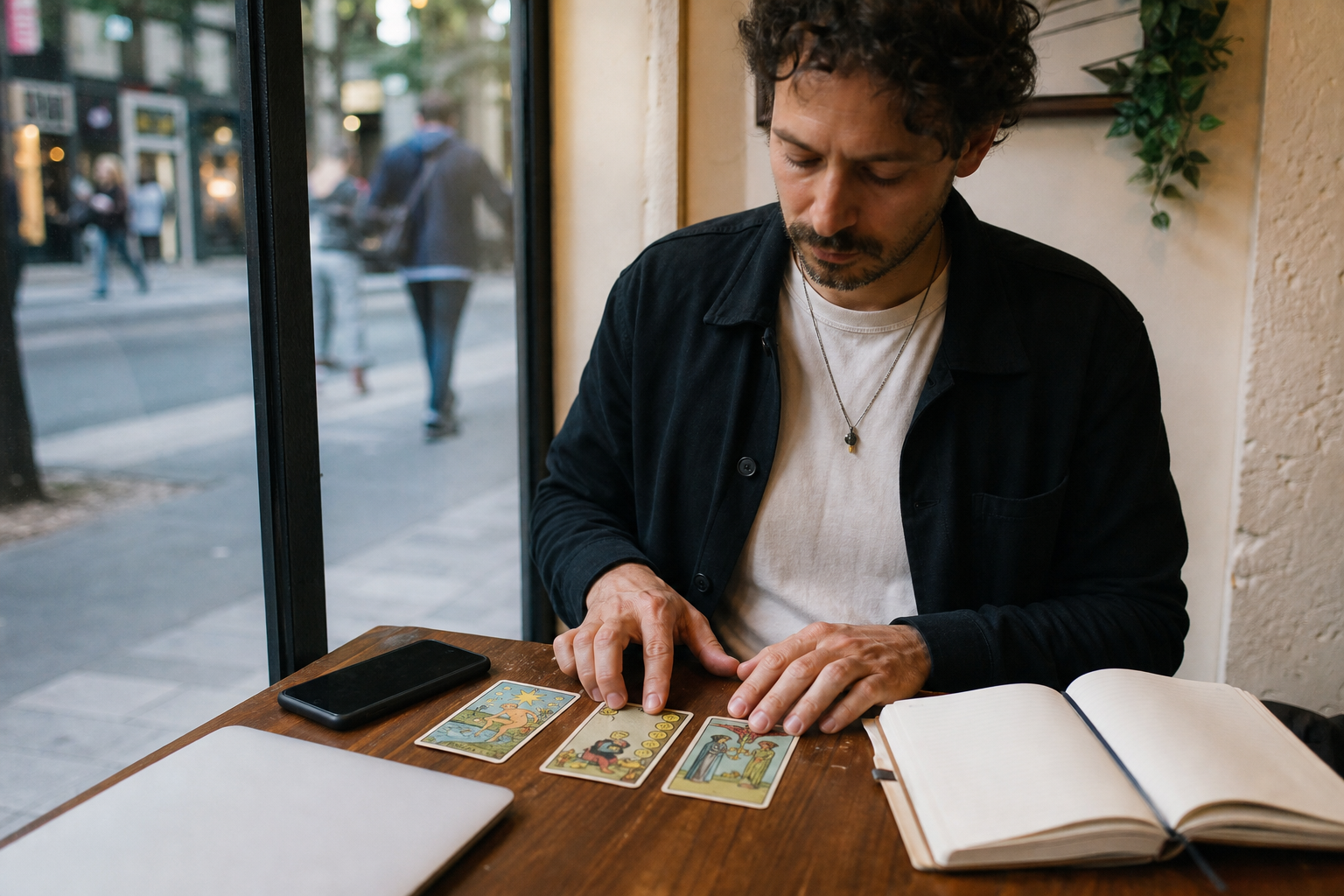
- Three cards Situation, obstacle, action. Or past, present, direction. Lay them face up.
- Write first Before looking anything up: what does each picture make you think about your question? Two lines each.
- Then the meanings Read the traditional meanings and notice where they add a thought. Choose one thing to do this week.
Ten minutes. The value is in the writing and the one action, not in the cards being right.
Why it helps, when it helps
Three mechanisms, none mysterious. First, framing: putting a worry into a question is half of thinking it through, and the ritual of shuffling makes you do it. Second, projection: an ambiguous picture pulls out what is already on your mind, the way an inkblot does, which surfaces thoughts you were avoiding. Third, permission: “the card says” lets people voice something they would not otherwise say to themselves. A reading that ends with a page of notes and one decision has done its job. A reading that ends with “the cards say he will come back” has not; see the section below.
Where it goes wrong
| Pattern | What it looks like | What to do instead |
|---|---|---|
| Literal reading | The Tower means disaster is coming; the Devil means someone is deceiving you | The cards are prompts. Ask what the picture makes you think about your question, not what it announces |
| Reading about other people | “Does she love me?” “Is he cheating?” | The deck cannot see anyone. Ask about your own side; see questions to ask |
| Compulsive re-reading | Drawing again until the answer is the one you wanted | One reading per question. Write it down and close the deck |
| Decisions by card | Taking the job because the Sun came up | Decide with information; use the cards to notice how you feel about the decision |
| Health, legal, money | Should I stop the medication? Will I win the case? | Never. Those go to professionals |
| A reader’s fear pivot | “This spread shows a curse / a block / negative energy around you” | End the session. This is the removal script with cards |
Reading for yourself versus paying for a reading
Reading for yourself costs a deck and ten minutes, and you can be as honest as you like. A paid reading adds a second person, which can be valuable (a good reader asks better questions than you ask yourself) or costly (a poor one tells you what you want to hear by the minute). If you pay, the safeguards in how to prepare for a psychic reading apply in full: posted price, specific questions, a timer, and no rebooking under pressure. How to spot a genuine tarot reader lists the tells.
Tarot and mental health
Some therapists use cards as prompts, and some people find a daily draw a useful check-in. That is the healthy end. The unhealthy end is using the deck to manage anxiety by asking it the same question every night, or to avoid a conversation, a decision, or a doctor. If you notice that the cards have become a way of not doing something, that is the moment to close the deck and do the thing. For grief, trauma, depression or anxiety, tarot can sit alongside help; it is not help. Spiritual practices and trauma covers where the line is.
Key takeaways
- Tarot is a set of pictures that prompt reflection; it does not know or foresee anything.
- Three cards, a real question, write before you look up meanings, choose one action. Ten minutes.
- It helps through framing, projection and permission. A reading should end with notes and a decision.
- Do not read literally, about other people, compulsively, or on health, legal or money questions.
- A reader who finds a curse or block in the cards is selling removal. End the session.
Frequently asked questions
1. Can tarot cards predict the future?
No. A shuffled deck has no information about events. Tarot is useful as a structured way to reflect on a question, and honest readers present it that way.
2. How do I do a simple tarot reading for myself?
Ask one real question, draw three cards (situation, obstacle, action), write two lines on what each picture makes you think before looking up meanings, then choose one thing to do this week.
3. Do I need to memorise all seventy-eight cards?
No. Start by responding to the pictures, then learn meanings gradually. A small reference booklet is fine; the point is the thinking, not the recall.
4. What is the best spread for beginners?
Three cards. Situation, obstacle, action; or past, present, direction. Larger spreads add complexity without adding insight for most questions.
5. What does it mean if I draw a scary card like the Tower or Death?
Nothing about events. The Tower traditionally prompts thoughts about sudden change; Death about endings and transitions. Ask what those themes bring up for your question.
6. Can I ask tarot about another person?
You can ask about your own situation with them and what you might do. Asking the deck what another adult feels or will do produces guesses, and it is where readings keep people stuck.
7. How often should I read?
Once per question. A daily single card as a check-in is fine for some people. Re-drawing until you like the answer, or reading every night about the same worry, is a sign to stop.
8. Is tarot religious or dangerous?
Neither. It is a set of pictures with a history in card games and later fortune-telling. Some religious traditions disapprove of divination; that is a matter for your own conscience, not a property of the cards.
9. Should I use tarot to make a decision?
Use it to notice how you feel about the options. Make the decision with information. If a card “tells” you to take the job, ask whether you wanted to anyway; that is the useful part.
10. Can tarot help with anxiety or depression?
As a reflection prompt, it can help you notice what you are feeling. It is not treatment, and using it to manage anxiety by repeated readings tends to make anxiety worse.
11. Are oracle or angel cards the same thing?
They work the same way (pictures as prompts) with different, usually gentler, imagery and no fixed structure. Use whichever you find easier to think with.
12. What if a reader says the cards show a curse or block?
End the session and pay nothing further. No spread shows a curse; the claim is the opening of a removal sale.
13. Do reversed cards matter?
Some readers use reversals to prompt an opposite or blocked reading; others ignore them. For reflection, do whichever gives you more to think about. Neither is more accurate, because accuracy is not what is happening.
14. Which deck should I buy?
Any deck whose pictures you like looking at. The Rider-Waite is the standard and most reference material describes it; many modern decks are gentler or more diverse. The images matter more than the tradition.
15. Is it better to pay for a reading or read for myself?
Reading for yourself is cheaper and often more honest. A good paid reader asks better questions than you ask yourself; a poor one tells you what you want to hear by the minute. If you pay, use the preparation checklist.
16. Can tarot be used for shadow work or journaling?
Yes; that is its best use. A card as a journaling prompt, with a time limit, is a sound practice. How long should you do shadow work? covers pacing.
Thinking of paying for a reading?
Our preparation guide covers choosing a reader you can check, questions that get useful answers, budget and timer, and what to do with what you hear.
Evidence check: there is no controlled evidence that tarot predicts events; the account of why it helps as reflection follows what is known about journaling prompts, projection and framing. Tarot is an interpretive practice; nothing here is medical, legal or financial advice.
If only my tarot deck had an ‘instant success’ card! I’d pull that one every time and avoid all my problems!
Maybe we should start a tarot-themed comedy night—’The Cards Say This Is Going Nowhere!’
Right?! And if it had a ‘bad decision’ card, I’d probably pull that one too!
Honestly, I find this whole tarot reading concept a bit silly. How can a few cards really provide guidance? It seems like a lot of wishful thinking rather than practical advice.
While some may dismiss tarot as mere superstition, it’s worth noting that its psychological benefits can be profound. Engaging with tarot can promote self-reflection and insight. Just make sure to approach it critically.
But isn’t relying on cards for guidance just another form of escapism? People should seek real solutions instead of turning to mystical readings.
That’s an interesting perspective! I think the self-reflection aspect is crucial, especially in times of uncertainty.
‘Your future can feel better’ sounds nice but isn’t that subjective? Isn’t it more about the choices we make rather than what some cards say?
I absolutely loved this article! Tarot reading has always intrigued me, and the way you explained the Three Card spread made it sound so accessible. I can’t wait to try it myself!
This article really speaks to me! I’ve always been curious about tarot and how people find guidance through it. It’s comforting to know there’s a tool for self-exploration and understanding.
Comforting, yes, but let’s not forget that no amount of card shuffling can replace hard work and personal responsibility!
‘Getting advice from cards’ sounds so ridiculous! What’s next? Seeking life tips from fortune cookies? Let’s focus on real-world solutions instead!
‘Fortune cookies are actually very wise!’ said no one ever who wanted genuine advice.
‘Tarot cards will tell you it is time to move’? Or maybe they just want you to shuffle them more! If only they could help with my procrastination too!